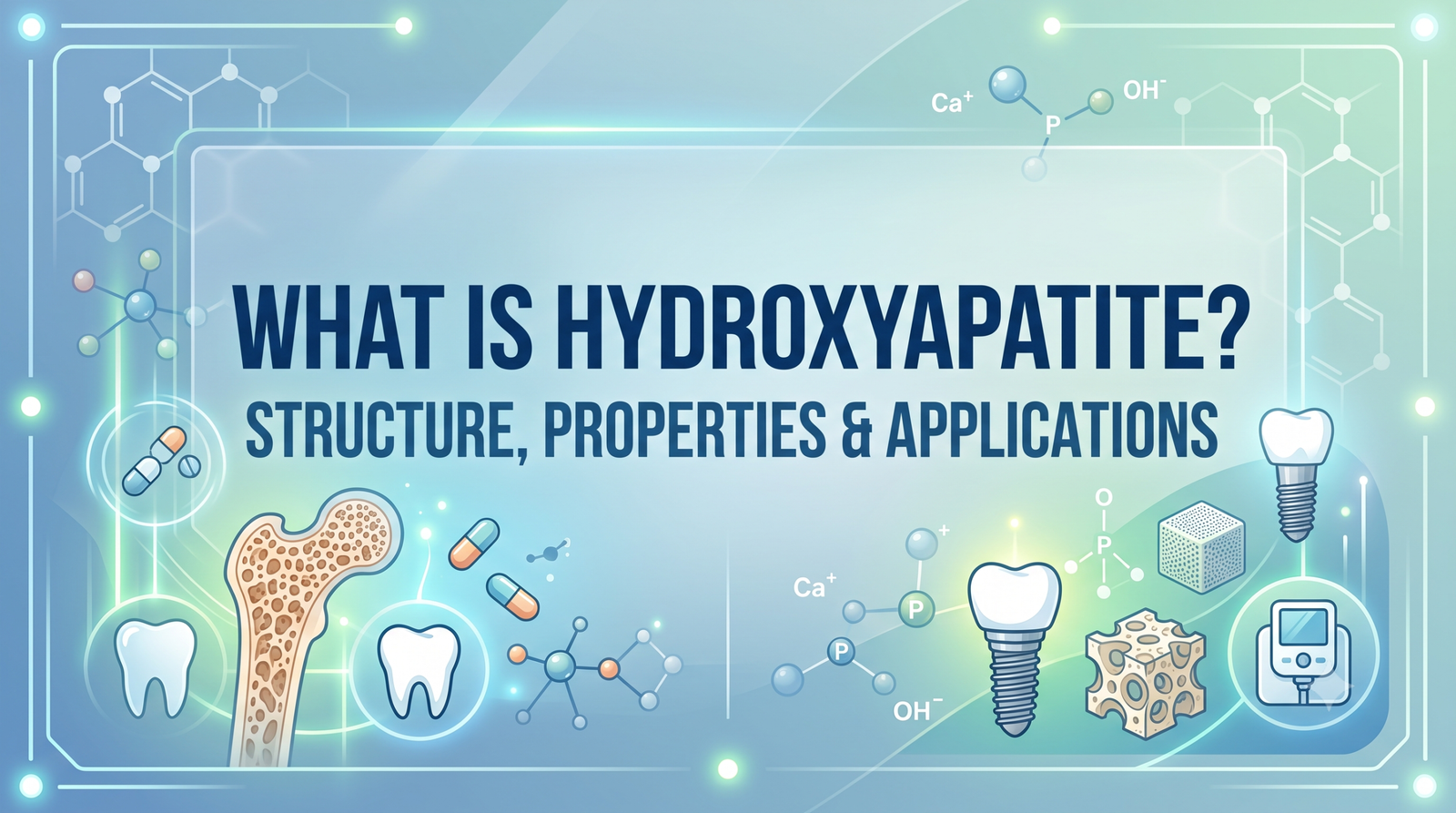
When we talk about materials that support the human body, few are as scientifically interesting as Hydroxyapatite. It is a calcium phosphate ceramic closely related to the mineral phase found in human bone and teeth, which is why it has become an important biomaterial in orthopaedics, dentistry, implant coatings, bone regeneration, and advanced tissue engineering.
But what exactly is Hydroxyapatite, how is its structure different from other calcium phosphates, what properties make it useful, and where is it actually applied?
This blog explains the science behind Hydroxyapatite in practical terms, while looking at its chemical composition, crystal structure, key properties, manufacturing routes, and major applications.
What Is Hydroxyapatite?
Hydroxyapatite, often abbreviated as HA or HAp, is a calcium phosphate ceramic with the ideal chemical formula Ca₁₀(PO₄)₆(OH)₂. In its stoichiometric form, it has a calcium-to-phosphorus (Ca/P) molar ratio of 1.67.
So, when asking “hydroxyapatite is made of what?”, the simplest answer is: calcium, phosphate and hydroxyl ions arranged in a specific apatite crystal structure.
The term also describes a naturally occurring hydroxyapatite mineral, although biological apatite is not usually chemically identical to perfectly pure, laboratory-grade HAp. Natural bone mineral is generally calcium-deficient, poorly crystalline and contains substitutions such as carbonate, magnesium and sodium.
This distinction is important because researchers and manufacturers may use the term HAp for materials with different degrees of crystallinity, particle size, stoichiometry and ionic substitution.
What Is the Structure of Hydroxyapatite?
The structure of Hydroxyapatite is one of the reasons it is so valuable in biomedical applications.
Stoichiometric HAp generally crystallizes in a hexagonal crystal system with P6₃/m symmetry. Its structure contains calcium ions, phosphate tetrahedra and hydroxyl ions arranged within a repeating crystal lattice. Reported lattice parameters are approximately a = 0.95 nm and c = 0.68 nm, depending on composition and measurement conditions.
The crystal contains two crystallographically distinct calcium sites. Phosphate groups form tetrahedral units, while hydroxyl ions occupy channels along the crystal structure. Importantly, this apatite lattice can accommodate partial ionic substitution. Carbonate, fluoride, magnesium, sodium and other ions can replace certain ions within the lattice.
This structural flexibility helps explain why biological apatite is different from pure hydroxyapatite.
In human bone, the mineral phase consists primarily of nanoscale apatite crystals associated with collagen. Bone is a complex composite rather than a block of HAp ceramic: its mineral fraction is generally around 60–70 wt%, with collagen and water forming the remaining major components.
How Is Hydroxyapatite Made?
Hydroxyapatite can be obtained from natural sources or produced synthetically.
Natural or biogenic sources investigated for HAp production include animal bone, eggshells and fish-derived materials. These approaches can produce apatite containing trace elements and structural features associated with biological mineral.
By contrast, synthetic hydroxyapatite is manufactured using controlled chemical processes. Common synthesis methods include wet chemical precipitation, sol-gel processing, hydrothermal synthesis, microwave-assisted synthesis and other advanced techniques. The selected process can influence particle size, morphology, crystallinity, purity, surface area and phase composition.
This is particularly important for commercial applications. A material intended for implant coating may require different particle-size distribution and crystallinity from HAp designed for oral-care formulations or porous bone scaffolds.
Key Properties of Hydroxyapatite
The popularity of Hydroxyapatite comes from a combination of chemical, physical and biological properties.
1. Biocompatibility
HAp has strong relevance to biomedical applications because its composition is closely related to the inorganic component of mineralized tissues. It is widely studied for bone and dental applications because of its compatibility with biological environments.
2. Bioactivity and Osteoconductivity
One of the defining advantages of HAp is its ability to interact with biological surroundings and support bone attachment and growth. It is described as osteoconductive, meaning it can provide a favorable surface for bone growth.
This makes HAp particularly attractive for bone substitutes, dental materials and implant coatings.
3. Chemical Stability
Stoichiometric HAp is relatively stable compared with several other calcium phosphate phases. Its solubility, however, is influenced by crystallinity, particle size, pH, temperature and ionic substitutions. Biological apatite is generally more soluble than highly crystalline geological or synthetic HAp.
4. High Surface Reactivity at Small Particle Sizes
When HAp is produced at the nanoscale, its high surface-area-to-volume ratio can significantly influence surface interactions and biological response. This has encouraged extensive research into nano-HAp for biomedical and dental applications.
5. Mechanical Limitations
HAp is not a perfect structural material. Like many ceramics, it is relatively brittle and has limited fracture toughness. Literature reports fracture toughness values for HAp ceramics generally around or below approximately 1.2 MPa·m¹ᐟ², substantially lower than reported values for human bone.
For this reason, HAp is often used in non-load-bearing applications, as a coating, or in combination with polymers, metals or other biomaterials rather than as a standalone replacement for highly load-bearing bone.
Major Applications of Hydroxyapatite
The properties of Hydroxyapatite have led to applications across several industries.
Orthopaedics and Bone Regeneration
HAp is widely researched for bone graft substitutes, bone fillers, porous scaffolds, spinal applications and maxillofacial reconstruction. Its osteoconductive nature makes it useful where the objective is to provide a mineral surface that supports bone integration.
Implant Coatings
One of the most established uses is applying HAp to metallic implant surfaces. A metal implant can provide mechanical strength, while the HAp coating is designed to create a biologically favorable interface with surrounding bone.
For implant coatings, factors such as particle size, coating thickness, porosity, phase composition and surface characteristics are important. FDA guidance and recognized standards for calcium-phosphate coatings reflect the importance of detailed characterization of these materials.
Dentistry and Oral Care
HAp is also relevant to dentistry because enamel and dentin contain calcium-phosphate mineral. Synthetic hydroxyapatite has therefore been investigated and used in oral-care formulations for applications including dentin hypersensitivity, remineralization and surface repair.
However, it is important not to overstate its performance. Scientific reviews note that clinical evidence across different HAp oral-care applications is still variable, and comparisons with fluoride-based approaches depend on the specific formulation and clinical indication.
Tissue Engineering
HAp can be combined with polymers, collagen and other biomaterials to create composite scaffolds that better reproduce the structure and mechanical behavior of natural bone. Such systems are being investigated for controlled degradation, cell interaction and tissue regeneration.
Pure Hydroxyapatite vs. Synthetic and Biological HAp
It is useful to understand that these terms are not always interchangeable.
Pure hydroxyapatite generally refers to stoichiometric or highly purified Ca₁₀(PO₄)₆(OH)₂. Synthetic hydroxyapatite describes HAp produced through a controlled manufacturing process; it may be stoichiometric, calcium-deficient or intentionally ion-substituted.
Biological HAp, on the other hand, is more chemically complex. Bone mineral contains carbonate and trace ionic substitutions and has a nanoscale, poorly crystalline structure.
Therefore, choosing the right HAp is not simply about asking whether a powder is “HAp.” Application-specific specifications such as purity, phase composition, crystallinity, particle size distribution, morphology and surface characteristics can be equally important thats why we Ceramat manufacture have HAp for different applications.
The Future of Hydroxyapatite
Research is moving beyond conventional HAp toward engineered materials with precisely controlled chemistry, morphology and surface properties. Ion-substituted HAp, nano-HAp, HAp-polymer composites and advanced coating technologies are being explored to improve biological performance and overcome limitations such as brittleness and slow resorption.
The practical lesson is simple: the performance of HAp depends not only on its chemical formula but also on how the material is produced and engineered for its final application.
For companies developing advanced biomaterials, selecting a reliable source with consistent composition, particle characteristics and quality specifications is therefore critical. Ceramat focuses on advanced ceramic materials and HAp solutions designed for demanding biomedical and technical applications, where material consistency and application-specific performance matter.
Conclusion
Hydroxyapatite is much more than a calcium phosphate powder. Its unique apatite crystal structure, biological relevance, chemical stability and osteoconductive behaviour have made it one of the most important ceramic biomaterials used in modern healthcare research and applications.
From bone graft materials and implant coatings to dental and oral-care technologies, HAp continues to connect materials science with biological performance. At the same time, understanding its limitations, particularly brittleness, fracture toughness and differences between synthetic and biological apatite is essential for using it correctly.
As material processing becomes more precise, the future of HAp will increasingly depend on controlling structure, chemistry, particle size and surface properties for specific applications rather than treating all HAp materials as identical.