If you’ve researched bone grafts, dental remineralization products, or bioceramic implant coatings, you’ve probably run into a wall of similar-sounding names: hydroxyapatite, tricalcium phosphate, dicalcium phosphate, octacalcium phosphate, amorphous calcium phosphate etc. They belong to the same chemical family and can look interchangeable on paper. In practice, they behave very differently and that difference decides whether a material resorbs in six weeks or outlasts the patient.
This article breaks down where calcium hydroxyapatite sits among the other calcium phosphates, using the numbers researchers measure in the lab: Ca/P ratio, solubility, crystallinity, and other parameters. Whether you’re formulating a bone graft, sourcing calcium hydroxyapatite powder for a coating line, or wondering why your toothpaste lists “calcium apatite” as an ingredient, this should give you a clear, evidence-based picture explained in a way that makes sense whether you’re a materials scientist or just someone curious about what’s actually in their toothpaste.
First, the Simple Version
Before we dive into ratios and solubility constants, here’s the plain-English version of what’s actually going on.
Imagine calcium and phosphate as two ingredients that can be combined in slightly different recipes, like how flour and water can make anything from a thin batter to a dense, hard bread crust, depending on the ratio and how it’s baked. Calcium phosphates work the same way: change the ratio of calcium to phosphate, and change how “cooked” (calcination) the mixture is, and you get a completely different material one that might dissolve in your mouth in seconds, or one that can sit inside a human skeleton for decades without breaking down.
At one end of this spectrum you have materials that are almost like sugar cubes, they dissolve fast, release their minerals quickly, and are gone. At the other end, you have something closer to a ceramic tile or a piece of chalk-turned-stone: dense, stable, and very slow to dissolve. Calcium hydroxyapatite sits at that second end. It’s the same mineral that makes up your bones and tooth enamel, which is exactly why it’s so stable — your body spent millions of years “choosing” the most durable version of calcium phosphate to build itself out of.
Every other compound in this Blog MCPM, DCPD, OCP, ACP, α-TCP, β-TCP is essentially a “faster-dissolving cousin” of hydroxyapatite. Some of them are even stepping stones that your own body naturally converts into hydroxyapatite as bones heal or teeth remineralize. Keep that one idea in mind as you read on: the further a compound sits from hydroxyapatite, the faster it dissolves and the less structurally permanent it is.
What Is Calcium Hydroxyapatite, Exactly?
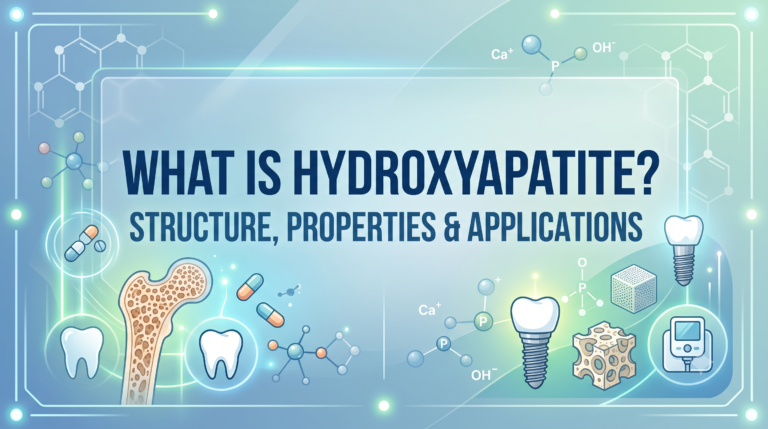
Calcium hydroxyapatite (Ca₁₀(PO₄)₆(OH)₂) is a naturally occurring calcium phosphate mineral that makes up roughly 60–70% of human bone by dry weight and about 97% of tooth enamel. It’s the most thermodynamically stable calcium phosphate phase under physiological conditions, a big part of why the body relies on it as its structural mineral.
Structurally, hydroxyapatite crystallizes in a hexagonal structure with a stoichiometric Ca/P molar ratio of 1.67. That single number is the biggest factor separating it from its other calcium phosphates.
Hydroxyapatite Head-to-Head: 10 Calcium Phosphates Compared
The real differences only become clear when you compare hydroxyapatite against each phase individually including the hydrated vs. anhydrous forms, and the precipitated vs. sintered forms of HA itself, which behave quite differently despite sharing a chemical formula. Here’s how HA stacks up against the other 9 calcium phosphates researchers and formulators work with most.
Ca/P Ratio
● HA: 1.67
● MCPM: 0.50
Crystal Structure
● HA: Hexagonal
● MCPM: Triclinic
Solubility
● HA: Insoluble, approximately 0.0003 g/L at 25°C.
● MCPM: Highly soluble, approximately 18 g/L at 25°C
Resorption / Degradation
● HA: Slow dissolution and relatively slow biological resorption.
● MCPM: Rapid dissolution and conversion/reaction in aqueous systems.
Density
● HA: 3.16 g/cm³
● MCPM: 2.22–2.23 g/cm³.
Chemical Formula
● HA: Ca₁₀(PO₄)₆(OH)₂
MCPM:Ca(H₂PO₄)₂·H₂O
Ca/P Ratio
● HA: 1.67
● DCP: 1.00
Crystal Structure
∙ HA: Hexagonal
∙ DCP: Triclinic
Solubility
● HA: Insoluble, approximately 0.0003 g/L at 25°C.
● DCP: ~0.048 g/L at 25°C.
Resorption / Degradation
● HA: Slow dissolution and relatively slow biological resorption.
● DCP: Faster dissolution and biological turnover.
Density
● HA: 3.16 g/cm³
● DCP: 2.92–2.93 g/cm³.
Chemical Formula
● HA: Ca₁₀(PO₄)₆(OH)₂
● DCP: CaHPO₄
Ca/P Ratio
● HA: 1.67
● DCPD: 1.00
Crystal Structure
● HA: Hexagonal
● DCPD: Monoclinic crystal structure.
Solubility
● HA: Insoluble, approximately 0.0003 g/L at 25°C.
● DCPD: 0.088 g/L at 25°C.
Resorption / Degradation
● HA: Slow dissolution and relatively slow biological resorption.
● DCPD: Faster dissolution and biological resorption.
Density
● HA: 3.16 g/cm³
● DCPD: 2.32 g/cm³.
Chemical Formula
● HA: Ca₁₀(PO₄)₆(OH)₂
● DCPD: CaHPO₄·2H₂O
Ca/P Ratio
● HA: 1.67
● OCP: 1.33
Crystal Structure
● HA: Hexagonal
● OCP: Triclinic, layered crystal structure.
Solubility
● HA: Insoluble, approximately 0.0003 g/L at 25°C.
● OCP: 0.0081 g/L at 25°C.
Resorption / Degradation
● HA: Slow dissolution and relatively slow biological resorption.
● OCP: Generally more readily dissolved/resorbed.
Density
● HA: 3.16 g/cm³
● OCP: 2.61–2.67 g/cm³.
Chemical Formula
● HA: Ca₁₀(PO₄)₆(OH)₂
● OCP: Ca₈(HPO₄)₂(PO₄)₄·5H₂O
Ca/P Ratio
● HA: 1.67
● Precipitated HA: Typically 1.50–1.67 depending on calcium deficiency.
Crystal Structure
● HA: Hexagonal
● Precipitated HA: Apatite structure, generally with lower crystallinity and more structural defects.
Solubility
● HA: Insoluble, approximately 0.0003 g/L at 25°C.
● Precipitated HA: Generally higher dissolution/reactivity when poorly crystalline or calcium-deficient.
Resorption / Degradation
● HA: Slow dissolution and relatively slow biological resorption.
● Precipitated HA: Can degrade/resorb faster because of smaller crystallites, defects and lower crystallinity.
Density
● HA: 3.16 g/cm³ theoretical density.
● Precipitated HA: Bulk/apparent density depends strongly on porosity and processing; theoretical crystal density is close to HA.
Chemical Formula
● HA: Ca₁₀(PO₄)₆(OH)₂
● Precipitated/calcium-deficient HA: Ca₁₀₋ₓ(HPO₄)ₓ(PO₄)₆₋ₓ(OH)₂₋ₓ
Ca/P Ratio
● HA: 1.67
● ACP: Variable, commonly approximately 1.2–2.2 depending on preparation.
Crystal Structure
● HA: Hexagonal
● ACP: Amorphous, without long-range crystalline order.
Solubility
● HA: Insoluble, approximately 0.0003 g/L at 25°C.
● ACP: Much more reactive and generally dissolves faster.
Resorption / Degradation
● HA: Slow dissolution and relatively slow biological resorption
● ACP: Rapid degradation/dissolution and possible transformation into apatite.
Density
● HA: 3.16 g/cm³.
● ACP: Reported values vary with composition and hydration; approximately 3.0 g/cm³ is commonly reported.
Chemical Formula
● HA: Ca₁₀(PO₄)₆(OH)₂
● ACP: CaₓHᵧ(PO₄)𝓏·nH₂O
Ca/P Ratio
● HA: 1.67
● MCP: 0.50
Crystal Structure
● HA: Hexagonal
● MCP: Triclinic calcium phosphate structure.
Solubility
● HA: Insoluble, approximately 0.0003 g/L at 25°C.
● MCP: 17 g/L at 25°C.
Resorption / Degradation
● HA: Slow dissolution and relatively slow biological resorption.
● MCP: Rapid dissolution and reaction.
Density
● HA: 3.16 g/cm³.
● MCP: 2.58 g/cm³ for anhydrous MCP according to crystallographic data.
Chemical Formula
● HA: Ca₁₀(PO₄)₆(OH)₂
● MCP: Ca(H₂PO₄)₂
Ca/P Ratio
● HA: 1.67
● α-TCP: 1.50
Crystal Structure
● HA: Hexagonal
● α-TCP: Monoclinic structure.
Solubility
● HA: Insoluble, approximately 0.0003 g/L at 25°C.
● α-TCP: 0.0025 g/L at 25°C.
Resorption / Degradation
● HA: Slow dissolution and relatively slow biological resorption.
● α-TCP: Faster dissolution and degradation.
Density
● HA: 3.16 g/cm³.
● α-TCP: 2.81–2.86 g/cm³.
Chemical Formula
● HA: Ca₁₀(PO₄)₆(OH)₂
● α-TCP: α-Ca₃(PO₄)₂
Ca/P Ratio
● HA: 1.67
● β-TCP: 1.50
Crystal Structure
● HA: Hexagonal
● β-TCP: Rhombohedral crystal structure.
Solubility
● HA: Insoluble, approximately 0.0003 g/L at 25°C.
● β-TCP: 0.0005 g/L at 25°C.
Resorption / Degradation
● HA: Slow dissolution and relatively slow biological resorption.
● β-TCP: Faster degradation and resorption.
Density
● HA: 3.16 g/cm³.
● β-TCP: 3.07–3.08 g/cm³.
Chemical Formula
● HA: Ca₁₀(PO₄)₆(OH)₂
● β-TCP: β-Ca₃(PO₄)₂
Ca/P Ratio
● HA: 1.67
● TTCP: 2.00
Crystal Structure
● HA: Hexagonal
● TTCP: Monoclinic crystal structure.
Solubility
● HA: Insoluble, approximately 0.0003 g/L at 25°C.
● TTCP: ~0.0007 g/L at 25°C.
Resorption / Degradation
● HA: Slow dissolution and relatively slow biological resorption.
● TTCP: More reactive and participates readily in calcium-phosphate reactions.
Density
● HA: ~3.16 g/cm³.
● TTCP: ~3.05 g/cm³.
Chemical Formula
● HA: Ca₁₀(PO₄)₆(OH)₂
● TTCP: Ca₄(PO₄)₂O
Why the Ca/P Ratio and Crystallinity Matter So Much
Two variables control almost everything about how a calcium phosphate performs in a biological or industrial setting:
- Ca/P molar ratio – Determines the crystal lattice structure and, broadly, the solubility ceiling of the compound.
- Crystallinity – Even at the same Ca/P ratio, a well-crystallized (sintered) material is dramatically less soluble than a poorly crystalline or nanostructured version of the same compound. Particle size compounds this effect: BET measurements on nano-calcium phosphates showed specific surface areas of roughly 12 to 50 m²/g, corresponding to equivalent particle diameters of about 38 to 172 nanometers — and higher surface area generally means faster dissolution, since more of the crystal lattice is exposed to fluid at once.
This is why particle engineering matters so much in commercial calcium hydroxyapatite powder production. A phase-pure, highly crystalline HA powder for implant coatings needs to behave completely differently from a nano-hydroxyapatite meant for fast-acting toothpaste remineralization even though both are, chemically, hydroxyapatite calcium phosphate.
Why This Matters, Even If You’ve Never Touched a Lab
It’s easy to assume this is all purely academic, but chances are you’ve encountered several of these compounds already, just without the chemistry names attached:
- Your toothpaste. If you’ve bought a fluoride-free “remineralizing” toothpaste in the last few years, there’s a good chance it contains nano-hydroxyapatite or ACP.
- A broken bone or dental implant. If a surgeon ever needs to fill a bone defect or anchor an implant, the choice between hydroxyapatite, β-TCP, or a biphasic blend of the two directly affects how long the material stays in place versus how quickly your own bone replaces it.
- Calcium and phosphate supplements. Some calcium supplements use more soluble calcium phosphates (like DCP) specifically because they’re easier for your digestive system to break down and absorb, compared to a highly crystalline, low-solubility form.
- Cosmetic dermal fillers. Calcium hydroxyapatite (often shortened to CaHA in the cosmetic industry) is used in injectable fillers because it’s biocompatible, gradually resorbs over roughly 12–18 months, and stimulates your body’s own collagen production along the way a very different profile from a filler designed to disappear in weeks.
The underlying idea in every one of these examples is the same one from earlier in this article: the compound’s solubility decides how long it lasts and what job it’s suited for. A toothpaste ingredient that needs to act in seconds and a hip implant coating that needs to last decades were never going to be made of the same material and now you know exactly why.
Conclusion
Choosing the “right” calcium phosphate isn’t about picking the most advanced-sounding compound it’s about matching Ca/P ratio, crystallinity, and particle morphology to what the application needs. Manufacturers who understand this distinction, and can control it consistently at production scale, are the ones producing calcium apatite materials that actually perform the way the literature says they should.That level of process control is harder to find than it sounds batch-to-batch phase purity in hydroxyapatite synthesis is notoriously difficult to hold steady. Ceramat, a specialized manufacturer of nano and thermal-spray-grade hydroxyapatite, builds its process around this exact problem: consistent Ca/P stoichiometry and crystallinity across every batch of hydroxyapatite powder, for applications from implant coatings to bone regeneration scaffolds.
Reference for technical details :- Synthetic amorphous calcium phosphates (ACPs): preparation, structure, properties, and biomedical applications
Frequently Asked Questions
Is calcium hydroxyapatite the same thing as “calcium”?
Not quite. Calcium is just one of the two elements in hydroxyapatite — the other is phosphate. Calcium hydroxyapatite is a specific mineral compound (Ca₁₀(PO₄)₆(OH)₂) made of both, arranged in a very particular crystal structure.
Why doesn’t the body just use the most soluble calcium phosphate?
Because bone and enamel need to stay solid and load-bearing for decades, not dissolve away. The body actually starts the mineralization process with more soluble, less stable precursor phases (like OCP) and gradually converts them into the far more stable hydroxyapatite — trading fast formation for long-term durability.
Is hydroxyapatite safe to put in the body?
Yes — it’s one of the most extensively studied and widely used biomaterials in medicine and dentistry, precisely because it is chemically almost identical to what your skeleton and teeth are already made of. That said, safety and performance still depend heavily on purity, particle size, and manufacturing quality, which is why sourcing from a controlled, quality-tested manufacturing matters for any clinical or cosmetic application.
What’s the difference between “calcium apatite” and “calcium hydroxyapatite”?
In practice, these terms are used interchangeably. “Apatite” is the general name for the mineral family that hydroxyapatite belongs to (other apatites include fluorapatite and chlorapatite), so “calcium apatite” is simply a shorter, more casual way of referring to calcium hydroxyapatite.