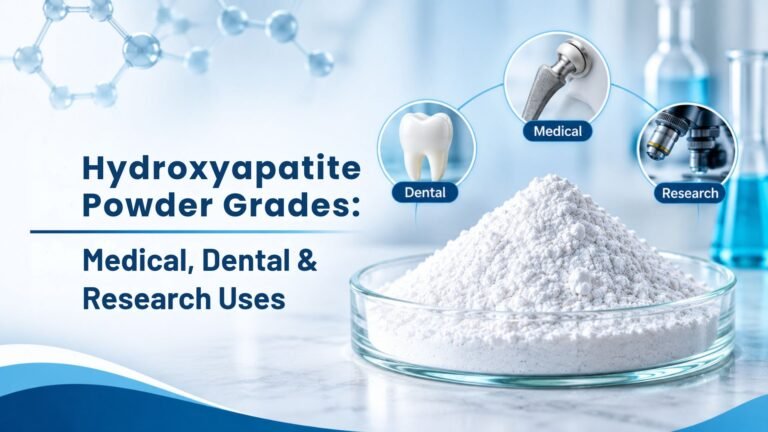
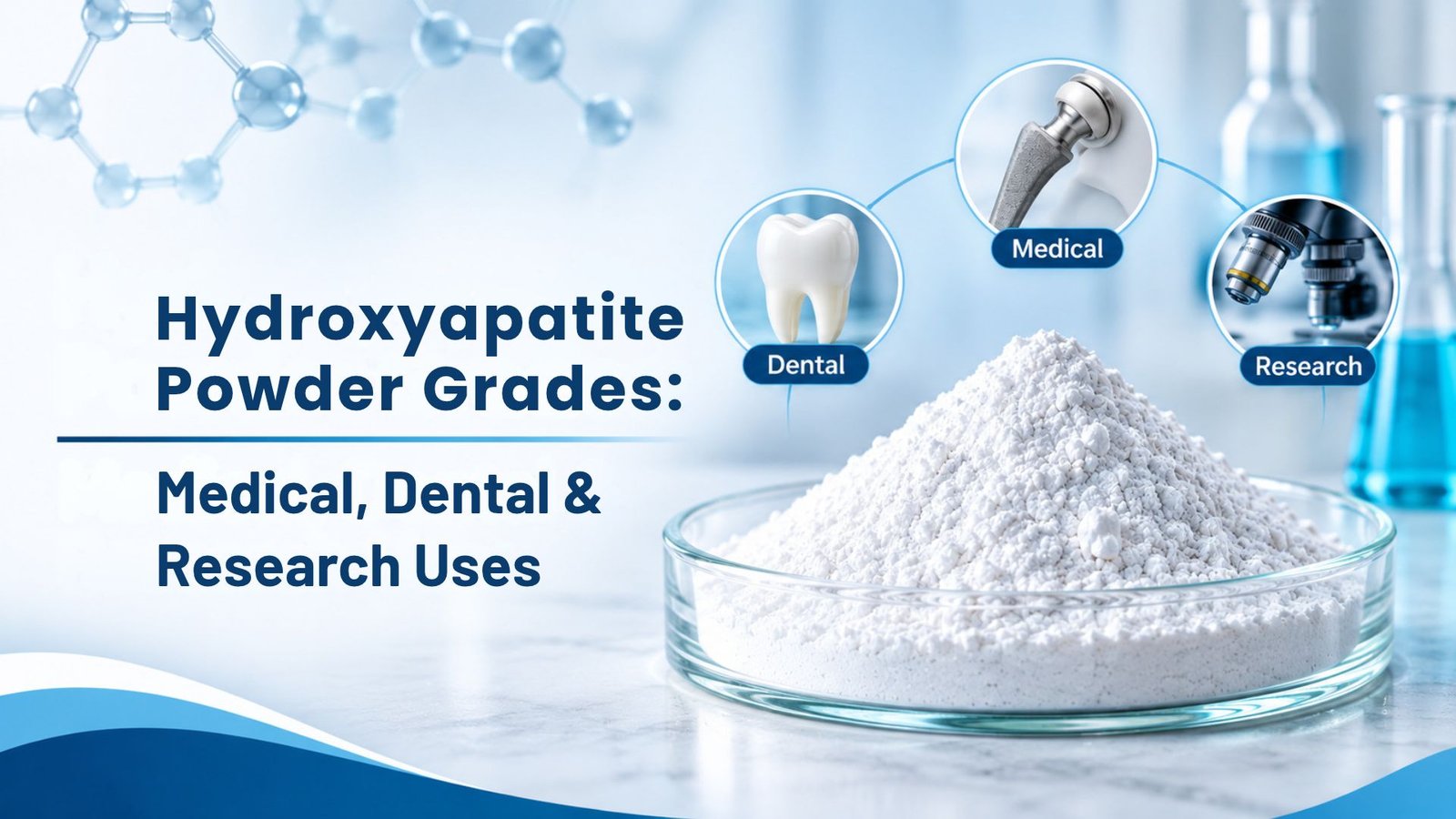
Hydroxyapatite Powder is widely studied and used in biomaterials, implant coatings, oral-care formulations and laboratory research. Its importance comes from its chemical similarity to the mineral component of human bones and teeth. However, its role differs across these applications. A powder used for coating a titanium implant has different processing requirements from one formulated for toothpaste or used to develop a bone-mimicking scaffold.
Understanding these differences helps manufacturers, researchers and product developers select a suitable material for their needs. This blog explores the medical, dental and research uses of hydroxyapatite, the scientific properties behind these applications, and the factors to consider when sourcing a Hydroxyapatite powder grade.
What Is Hydroxyapatite Powder?
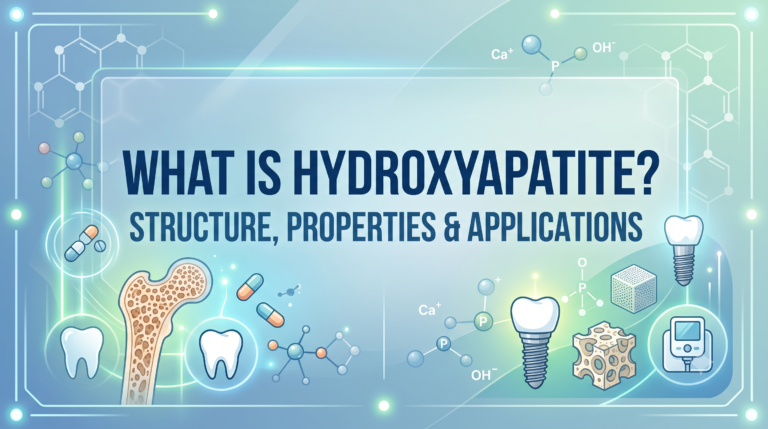
Hydroxyapatite (HA or HAp) is a calcium-phosphate ceramic with the ideal chemical formula Ca₁₀(PO₄)₆(OH)₂. Its theoretical calcium-to-phosphorus atomic ratio is approximately 1.667.
Hydroxyapatite is particularly relevant to biomaterials because it resembles the mineral phase of natural bone and teeth. Biological apatite, however, is more complex than ideal synthetic hydroxyapatite and may contain substitutions, such as carbonate, that influence its properties.
The performance of Hydroxyapatite Powder depends on more than its chemical name. Crystalline phase composition, purity, particle size, morphology, surface area and manufacturing process can influence how it behaves during coating, formulation or material development.
1. Medical Uses of Hydroxyapatite Powder
Medical applications focus primarily on bone-related biomaterials, implant surface coatings and the development of materials that interact with bone tissue.
Implant Coatings and Osseointegration
One of the established applications of hydroxyapatite is coating the surfaces of orthopaedic and dental implants. Titanium and titanium-alloy implants provide mechanical strength, while a hydroxyapatite coating can introduce a bioactive calcium-phosphate surface that supports interaction with bone.
Osseointegration refers to the functional connection between an implant and surrounding bone. Hydroxyapatite coatings have been studied for their ability to support bone apposition and improve the biological response at the implant surface.
For this application, the powder must engineered for the selected thermal-spray process. Atmospheric Plasma Spray (APS), for example, exposes feedstock to high temperatures. Particle-size distribution, flowability and thermal behaviour can influence deposition and the resulting coating.
The finished coating must also be evaluated for phase composition, thickness, porosity, adhesion and mechanical integrity. Therefore, selecting the right hydroxyapatite powder is an important part of the process, but powder specifications alone cannot guarantee implant performance.
Bone Grafts and Regenerative Biomaterials
Hydroxyapatite is also used in developing bone substitutes, porous scaffolds and composite biomaterials. Its osteoconductive character makes it useful as a material that can support bone growth along an appropriate surface or structure.
Researchers and medical-material developers incorporate hydroxyapatite into granules, porous ceramics, composites and scaffold systems designed for bone-defect studies and regenerative applications.
Its behaviour depends on crystallinity, porosity, composition and structural design. Hydroxyapatite is relatively stable compared to more soluble calcium-phosphate phases, such as beta-tricalcium phosphate (β-TCP). As a result, researchers may investigate either material alone or combinations of both to study the balance between structural stability and resorption.
Drug Delivery and Tissue Engineering
Hydroxyapatite-based materials are being investigated as carriers for selected therapeutic substances and as components of tissue-engineering scaffolds. Their surface chemistry allows interactions with certain molecules, while porous structures can provide sites for loading and release.
However, drug-loading capacity and release behaviour depend on factors such as surface area, porosity, composition and surface modification. These applications require experimental validation rather than assumptions based on the material’s name alone.
2. Dental Uses of Hydroxyapatite Powder
Dental applications extend beyond implant coatings to include toothpaste development, enamel remineralisation research and products designed to manage dentine hypersensitivity.
Toothpaste and Oral-Care Formulations
Hydroxyapatite is studied as an active ingredient in oral-care products because tooth enamel is largely mineral-based and contains biological apatite. Appropriately formulated nano hydroxyapatite particles may deposit on tooth surfaces and contribute to mineral-rich surface layers.
Depending on the formulation and supporting evidence, nano hydroxyapatite containing toothpaste is investigated for enamel remineralisation and reducing dentine hypersensitivity. A systematic review of clinical studies has reported beneficial findings for hydroxyapatite-based oral-care products in managing dentine hypersensitivity, although results depend on the formulation, comparator and study design.
For toothpaste manufacturers, the important question is not simply whether a powder contains hydroxyapatite. Particle morphology, size distribution, purity, dispersion and compatibility with the complete formulation should also be considered.
Ingredient-grade and consumer-grade powders may be evaluated for toothpaste, mouthwash and related oral-care products. Oral care product developers should therefore verify the material specifications, current regulatory position and finished-product requirements before commercialisation.
Dental Implant Coatings
Hydroxyapatite also has a role in the development of bioactive coatings for dental implants. The aim is to support interaction between the implant surface and surrounding bone.
The coating process, phase stability, surface structure and adhesion are central considerations. Accordingly, the powder selected for dental implant coatings may be different from the ingredient used in an oral-care formulation.
3. Hydroxyapatite Powder for Research
Research applications provide the foundation for improving existing biomaterials and developing new ones. Laboratories use hydroxyapatite to investigate material synthesis, biological interactions, processing methods and the influence of composition on performance.
Biomaterial Development and 3D Printing
Researchers use hydroxyapatite in the development of porous scaffolds & ceramic structures. Additive manufacturing, including selected extrusion- and light-based printing approaches, allows researchers to investigate complex geometries and controlled pore structures.
The success of a formulation depends on factors such as powder size, dispersion, solid loading, rheology and sintering behaviour. A powder suitable for one printing process may not perform equally well in another.
Calcium-Phosphate and Material Characterization Studies
Hydroxyapatite is frequently studied alongside other calcium-phosphate materials, including CDHA and β-TCP. Comparing their phase composition, solubility and structural properties helps researchers understand how differences in chemistry affect material behaviour.
Analytical methods are essential for reliable results. X-ray diffraction (XRD) helps identify crystalline phases, while particle-size analysis and electron microscopy can help characterise size distribution and morphology. Elemental analysis may be used to assess calcium, phosphorus and trace impurities.
Using the appropriate methods helps researchers verify whether a material matches the intended specification and improves the reproducibility of experiments.
Drug Delivery and Experimental Formulations
Research teams also investigate hydroxyapatite-based systems for drug loading, controlled release, tissue engineering and other specialised applications. These studies may examine how porosity, surface chemistry and particle dimensions influence performance.
In these applications, the required powder characteristics depend on the research question. A well-characterised material with documented batch information can make comparisons between formulations and experiments more meaningful.
How to Choose Hydroxyapatite Powder for Your Application
Before purchasing, define the intended use (Application) and identify the material properties that matter most.
For implant coatings, examine particle-size distribution, flowability, phase composition and compatibility with the coating process. On other hand oral-care formulations, assess purity, morphology, dispersion and the relevant safety and regulatory requirements. For laboratory research, prioritise the chemical and physical specifications needed to make the study repeatable.
Request a current technical data sheet, safety data sheet and batch-specific certificate of analysis. Where relevant, ask for XRD results, particle-size data & morphology information.
When you plan to buy calcium hydroxyapatite powder in bulk, confirm the available pack sizes, batch consistency, lead times and suitability for scale-up. Comparing suppliers on documented specifications is more useful than comparing price alone.
Ceramat give it all according to the grade you best suited for your application.
Ceramat’s Hydroxyapatite Grades for Diverse Applications
1. Hydroxyapatite Powder – Hydroxyapatite powder with 99% phase purity, designed for laboratory research, material development, and manufacturing applications requiring well-defined HAp composition.
2. Hydroxyapatite Powder – Thermal Spray Grade: Specially developed HAp powder for thermal spraying of biomedical implants. Its controlled particle size and flowability support consistent powder feeding and the development of reliable implant coatings.
3. Calcium-Deficient Hydroxyapatite – (CDHA) A bioactive calcium phosphate material with a composition similar to the mineral found in natural bone. Its resorbable nature makes it suitable for bone regeneration research, tissue engineering, drug delivery, and dental regenerative applications.
4. Ingredient Grade nano Hydroxyapatite Powder – (Oral Care and Cosmetic Applications) High-purity hydroxyapatite with over 97% chemical purity and consistent rod-shaped, nano-grade morphology. Developed as a raw material for toothpaste, tooth powders, mouthwash, enamel remineralisation formulations, and cosmetic products.
5. Consumer Grade nano Hydroxyapatite Powder – Synthetic nano-hydroxyapatite powder with controlled phase purity and fine particle characteristics. Designed for consumer-focused oral care, cosmetic, and personal care formulations where consistent material quality is important.
6.CeraSanchit – A hydroxyapatite-based material containing over 85% HAp. Developed for oral care formulations, including toothpaste, where it can be used as a calcium phosphate ingredient.
7. IG-Advance – A hydroxyapatite ingredient grade developed for oral care and cosmetic applications. Suitable for manufacturers developing toothpaste and other oral care formulations requiring consistent hydroxyapatite quality.
Conclusion
Hydroxyapatite Powder supports a broad range of medical, dental and research applications, but its suitability depends on the properties required for each use. Understanding the chemistry, particle characteristics and processing requirements helps manufacturers and researchers make informed decisions.
Ceramat Private Limited manufacture hydroxyapatite and other calcium-phosphate materials for implant coating, biomaterial development, oral-care formulation and research. Explore the Ceramat product range to review application-focused options and contact the team for technical specifications, samples or bulk-supply enquiries.
Frequently Asked Questions
What is Hydroxyapatite Powder used for?
It is used in implant coatings, bone-related biomaterials, dental oral-care formulations and research into scaffolds, composites and drug-delivery systems.
Is medical-grade hydroxyapatite suitable for toothpaste?
Not automatically. A powder developed for thermal spraying or other medical-material processing may not meet the particle, formulation or regulatory requirements of an oral-care product.
What is the difference between hydroxyapatite and calcium-deficient hydroxyapatite?
Stoichiometric hydroxyapatite has a theoretical Ca/P atomic ratio of approximately 1.667.
Calcium-deficient hydroxyapatite has a lower ratio and a different composition, which can influence its solubility and behaviour in biomaterial systems.
What should I check when sourcing hydroxyapatite powder in bulk?
Check purity, phase composition, particle-size distribution, morphology, relevant process requirements, batch documentation and supply consistency. The required tests depend on the intended application.